News of the week in plain Finnish | Saturday 15.8.2026
Errors in economic forecasts.
Listen
You can read the news simultaneously below.
(The weekly news program in plain Finnish will not be broadcast on Saturday, August 15th on Radio Suomenland, because Radio Suomi will be broadcasting a program about the European Athletics Championships.)
Introducing the topic of the week
This time the topic of the program is errors in economic forecasts.
The Kalevi Sorsa Foundation published a report on economic forecasts this week.
The report says that experts’ economic forecasts often fail miserably.
We will now tell you more about why economic forecasts fail and what the consequences are.

Open image viewer
Researchers Lauri Finér and Jussi Systä have studied economic forecasts. They work at the Kalevi Sorsa Foundation. Photo: Esa Syväkuru / Yle
The problem with economic forecasts
The Kalevi Sorsa Foundation studied how Finnish experts predict economic growth and economic turnarounds.
Predictions rarely come true.
The problem is that forecasters make predictions based on statistical data. However, the statistical data is often old or inaccurate.
Because experts do not know the exact current state of the economy, it is impossible for them to predict the future economic situation well.
Predictions are sometimes correct only by chance.
Economic forecasts and government decisions
Open image viewer
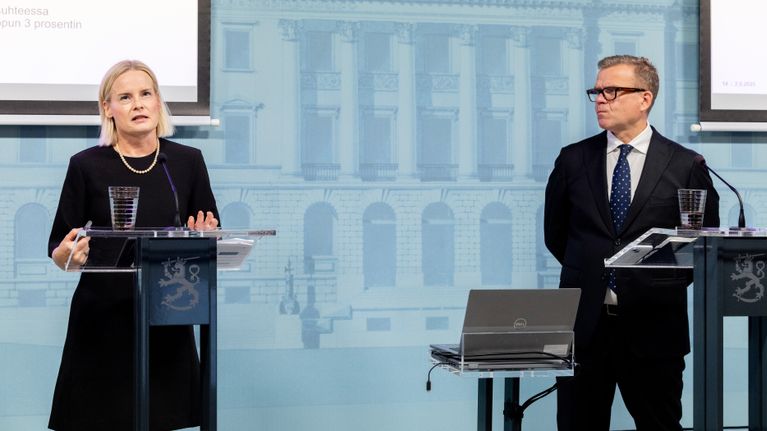
Minister of Finance Riikka Purra and Prime Minister Petteri Orpo use economic forecasts to make many decisions in the government. Photo: Henrietta Hassinen / Yle
The Finnish government makes important decisions based on economic forecasts.
That is why incorrect economic forecasts are a big problem for society.
For example, the Ministry of Finance makes forecasts that the government uses when it plans the state budget.
The government reads forecasts when it assesses adjustment needs, i.e. makes decisions on taxes and cuts.
Researchers warn that politicians may make the wrong decisions because the forecasts are inaccurate.
Researchers say politicians should not rely too much on economic forecasts.
Researchers recommend that politicians use recent figures and information from tax authorities.
Economic forecasters
Open image viewer
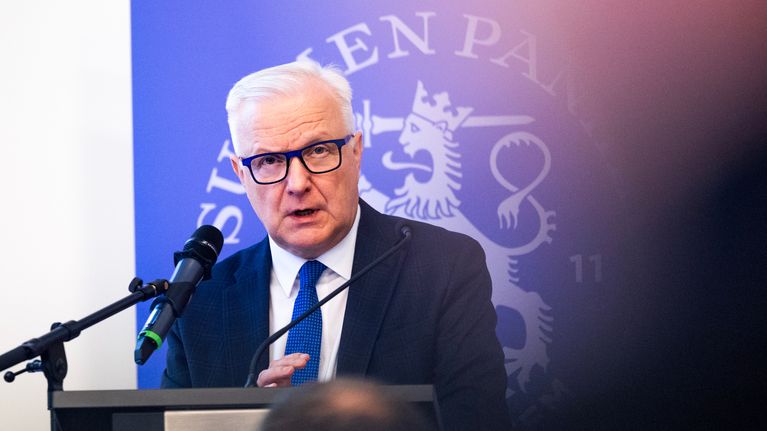
Economic forecasts are prepared by the Bank of Finland, for example. The picture shows the Governor of the Bank of Finland, Olli Rehn. Photo: Jussi Koivunoro / Yle
Many different institutions make economic forecasts in Finland.
Forecasts are made by, for example, the Ministry of Finance, the Bank of Finland and Pellervo Economic Research.
They defend economic forecasts.
Forecasters admit that it is difficult to estimate exact figures and economic changes in advance.
However, forecasters say that forecasts are helpful to decision-makers.
Forecasters say that what matters is the overall big picture of the economy, not the small numbers.
Repetition
This week’s news in plain Finnish reported on economic forecasts.
Let’s repeat the most important things.
A new report from the Kalevi Sorsa Foundation shows that experts’ economic forecasts often fail because the initial data is inaccurate.
Researchers want politicians to make economic decisions based on the actual situation, not on forecasts.
Forecasting agencies defend the forecasts and say that they are nevertheless helpful to decision-makers.
This was the news of the week in plain Finnish. See you again, bye!